Ganita Manjari Class 9 Maths Chapter 1 Solutions: Orienting Yourself – The Use of Coordinates
CBSE Written Solutions: Coordinate Geometry
Grade 9 Mathematics
Exercise Set 1.1
[Question (i)]
Referring to Fig. 1.3, answer the following questions: (i) If \( D_1R_1 \) represents the door to Reiaan’s room, how far is the door from the left wall (the y-axis) of the room? How far is the door from the x-axis?

- Concept Recap: The distance of a point from the y-axis is measured by its x-coordinate, and the distance of a point from the x-axis is measured by its y-coordinate.
- Given: The left wall is the y-axis, and the wall with the door is the x-axis. The door starts at point \( D_1 \). Point \( D_1 \) is marked at the number 8 on the x-axis.
- To Find: The perpendicular distance of the door \( (D_1) \) from the left wall (y-axis) and from the x-axis.
- Step-by-Step Working:
- Locate the starting point of the door, \( D_1 \).
- Read the x-coordinate of \( D_1 \) from the graph. The point aligns with +8 on the x-axis.
- The distance from the y-axis (left wall) is exactly the x-coordinate. Therefore, Distance = 8 units (8 feet, as per the room’s scale).
- Observe that the door \( D_1R_1 \) lies perfectly on the x-axis.
- Any object lying exactly on the x-axis has moved 0 units up or down. Thus, its distance from the x-axis is 0.
- Final Answer: The door is 8 feet away from the left wall (the y-axis) and 0 feet away from the x-axis.
[Question (ii)]
What are the coordinates of \( D_1 \)?
- Concept Recap: The coordinates of any point are written in the format \( (x, y) \). For any point lying directly on the x-axis, the y-coordinate is always zero.
- Given: Point \( D_1 \) lies on the x-axis at a distance of 8 units to the right of the origin.
- To Find: The exact coordinate pair \( (x, y) \) for point \( D_1 \).
- Step-by-Step Working:
- From our previous finding, the distance along the x-axis (x-coordinate) is +8.
- Since the point lies on the x-axis, it has no vertical elevation or depression. Hence, the y-coordinate is 0.
- Grouping them in the standard \( (x, y) \) format gives \( (8, 0) \).
- Final Answer: The coordinates of point \( D_1 \) are \( (8, 0) \).
[Question (iii)]
If \( R_1 \) is the point \( (11.5, 0) \), how wide is the door? Do you think this is a comfortable width for the room door? If a person in a wheelchair wants to enter the room, will he/she be able to do so easily?
- Concept Recap: The distance between two points that lie on the same horizontal line (the x-axis) is found by taking the absolute difference of their x-coordinates.
- Given: Point \( D_1 = (8, 0) \). Point \( R_1 = (11.5, 0) \).
- To Find: The width of the door (distance from \( D_1 \) to \( R_1 \)) and to logically deduce if it is wheelchair accessible.
- Step-by-Step Working:
- Width of the door = \( |x_2 – x_1| \)
- Substituting the x-coordinates: Width = \( |11.5 – 8| \)
- Width = 3.5 units. Since the room dimensions are in feet, the width is 3.5 feet.
- A standard wheelchair requires a minimum clear width of about 32 inches (approx 2.67 feet).
- Compare the two widths: 3.5 feet > 2.67 feet.
- Final Answer: The door is 3.5 feet wide. Yes, this is a very comfortable width, and a person in a wheelchair will be able to enter the room easily.
[Question (iv)]
If \( B_1(0, 1.5) \) and \( B_2(0, 4) \) represent the ends of the bathroom door, is the bathroom door narrower or wider than the room door?
- Concept Recap: The distance between two points that lie strictly on the y-axis is the absolute difference between their y-coordinates.
- Given: Ends of the bathroom door are \( B_1(0, 1.5) \) and \( B_2(0, 4) \). Width of the room door = 3.5 feet.
- To Find: The width of the bathroom door and a size comparison with the room door.
- Step-by-Step Working:
- Notice that the x-coordinates for both \( B_1 \) and \( B_2 \) are 0. This means the bathroom door lies perfectly on the y-axis.
- Width of bathroom door = \( |y_2 – y_1| \)
- Substitute the y-coordinates: Width = \( |4 – 1.5| \)
- Perform the subtraction: Width = 2.5 units (or 2.5 feet).
- Compare with the room door: 2.5 feet < 3.5 feet.
- Final Answer: The bathroom door is 2.5 feet wide. Therefore, the bathroom door is narrower than the room door.
Think and Reflect (Page 5)
[Question 1 & 2]
1. What are the standard widths for a room door? Look around your home and in school.
2. Are the doors in your school suitable for people in wheelchairs?
- Concept Recap: Applying mathematical measurements (geometry and coordinates) to real-world architectural and accessibility standards.
- Step-by-Step Working:
- For Question 1: Standard residential and commercial interior doors typically range from 30 inches to 36 inches in width. Converting this to feet (1 foot = 12 inches), this is 2.5 feet to 3 feet.
- For Question 2: According to accessibility guidelines, a doorway must have a minimum clear width of 32 inches (approx 2.67 feet) for a wheelchair to pass safely. Most modern schools are built with doors that are 36 inches (3 feet) wide or larger.
- Final Answer: 1. Standard widths for a room door typically range from 2.5 feet to 3 feet (30 to 36 inches). 2. Yes, standard school doors are generally 3 feet wide or more, making them legally and practically suitable for people in wheelchairs.
Think and Reflect (Page 7)
[Question 1]
What is the x-coordinate of a point on the y-axis?
- Step-by-Step Working:
- The x-coordinate of a point measures how far left or right it is from the y-axis.
- If a point is located exactly on the y-axis, it has not moved left or right at all.
- Therefore, its horizontal displacement is zero.
- Final Answer: The x-coordinate of any point on the y-axis is always 0.
[Question 2]
Is there a similar generalisation for a point on the x-axis?
- Step-by-Step Working:
- The y-coordinate dictates how far up or down a point is from the x-axis.
- If a point is on the x-axis, its vertical elevation or depression is exactly zero.
- Final Answer: Yes, there is a similar generalization: The y-coordinate of any point on the x-axis is always 0.
[Question 3 & 4]
2. Does point \( Q(y, x) \) ever coincide with point \( P(x, y) \)? Justify your answer.
4. If \( x \neq y \), then \( (x, y) \neq (y, x) \); and \( (x, y) = (y, x) \) if and only if \( x = y \). Is this claim true?

- Step-by-Step Working:
- Let’s test with a random number pair where \( x \neq y \). Let \( x = 2 \) and \( y = 3 \).
- Point \( P \) becomes \( (2, 3) \). Point \( Q \) becomes \( (3, 2) \).
- Plotting them shows they are clearly in different physical locations. Therefore, if \( x \neq y \), then \( (x, y) \neq (y, x) \).
- Now let \( x = y \). Let \( x = 4 \) and \( y = 4 \).
- Point \( P \) is \( (4, 4) \) and point \( Q \) is \( (4, 4) \). They plot to the exact same physical location.
- Final Answer: 3. Yes, point \( Q(y, x) \) coincides with point \( P(x, y) \) only when the values of \( x \) and \( y \) are equal (i.e., \( x = y \)).
4. Yes, the claim is absolutely true because the Cartesian system relies on strictly ordered pairs.
Exercise Set 1.2
[Question 1]
Place Reiaan’s rectangular study table with three of its feet at the points \( (8, 9) \), \( (11, 9) \) and \( (11, 7) \). (i) Where will the fourth foot of the table be? (ii) Is this a good spot for the table? (iii) What is the width of the table? The length? Can you make out the height of the table?

- Given: Three vertices of a rectangular table: \( V_1(8, 9) \), \( V_2(11, 9) \), and \( V_3(11, 7) \).
- Step-by-Step Working:
- For part (i): The fourth vertex \( V_4 \) must align horizontally with \( V_3(11, 7) \) and vertically with \( V_1(8, 9) \).
- Therefore, \( V_4 \) takes the x-coordinate of \( V_1 \) (8) and the y-coordinate of \( V_3 \) (7). Thus, \( V_4 = (8, 7) \).
- For part (ii): The coordinates \( (8, 7) \) to \( (11, 9) \) place the table in the top-right corner of the bedroom. This is a good spot because it is out of the main walking path from the door \( D_1(8, 0) \).
- For part (iii): Width (distance along x-axis) = \( |11 – 8| = 3 \) feet. Length (distance along y-axis) = \( |9 – 7| = 2 \) feet. The height cannot be determined because this is a 2D floor map.
- Final Answer: (i) The fourth foot will be at \( (8, 7) \). (ii) Yes, it is a good spot in the top right corner. (iii) The width is 3 ft, the length is 2 ft, and the height cannot be determined from a 2D map.
[Question 2]
If the bathroom door has a hinge at \( B_1 \) and opens into the bedroom, will it hit the wardrobe? Are there any changes you would suggest if the door is made wider?

- Given: Hinge is at \( B_1(0, 1.5) \). The door ends at \( B_2(0, 4) \). The wardrobe is on the bottom wall, extending from \( x = 3 \) to \( x = 7 \).
- Step-by-Step Working:
- Calculate the length of the bathroom door: Radius = \( |4 – 1.5| = 2.5 \) feet.
- The maximum horizontal distance the door will reach into the room is equal to its length: \( 0 + 2.5 = 2.5 \) feet on the x-axis.
- Since 2.5 ft < 3 ft, the fully opened door will not reach the wardrobe.
- If made wider (e.g., 3.5 ft): A 3.5 ft door swinging from \( B_1 \) would reach \( x = 3.5 \). This would overlap with the wardrobe.
- Suggestion: If the door is made wider, the hinge should be moved to \( B_2(0, 4) \) or the door should open outwards into the bathroom.
- Final Answer: No, the 2.5 ft door will not hit the wardrobe because it only reaches \( x = 2.5 \), while the wardrobe starts at \( x = 3 \). If the door is made wider (e.g., 3.5 ft), it would hit the wardrobe. A suggested change is to move the hinge to \( B_2(0, 4) \) or have the door swing into the bathroom.
[Question 3]
Look at Reiaan’s bathroom. (i) What are the coordinates of the four corners O, F, R, and P of the bathroom? (ii) What is the shape of the showering area SHWR in Reiaan’s bathroom? Write the coordinates of the four corners. (iii) Mark off a 3 ft × 2 ft space for the washbasin and a 2 ft × 3 ft space for the toilet. Write the coordinates of the corners of these spaces.

- Step-by-Step Working:
- For part (i): The origin \( O \) is \( (0, 0) \). The bathroom extends left along the x-axis to -5, so \( P = (-5, 0) \). The ceiling extends up the y-axis to 10, so \( F = (0, 10) \). The top left corner is \( R = (-5, 10) \).
- For part (ii): The showering area SHWR starts at \( R(-6, 9) \). It extends 4 units right to \( x = -2 \) (Point W) and 3 units down to \( y = 6 \) (Point S). Since all sides are of different lengths and angle R and S are 90° each, it forms a trapezium as SH is parallel to RW. Corners: \( R(-6, 9) \), \( W(-2, 9) \), \( H(-3, 6) \), \( S(-6, 6) \).
- For part (iii): Possible placement: Place the washbasin at the bottom-left corner. It takes a space of 3 on x and 2 on y. Coordinates: \( (-5, 0) \), \( (-2, 0) \), \( (-2, 2) \), \( (-5, 2) \). Place the toilet on the bottom-right, next to the door. Coordinates: \( (-2, 0) \), \( (0, 0) \), \( (0, 3) \), \( (-2, 3) \).
- Final Answer: (i) \( O(0, 0) \), \( F(0, 10) \), \( R(-5, 10) \), \( P(-5, 0) \). (ii) The shape is a trapezium. Corners: \( R(-6, 9) \), \( W(-2, 9) \), \( H(-3, 6) \), \( S(-6, 6) \). (iii) Washbasin (3×2): \( (-5, 0) \), \( (-2, 0) \), \( (-2, 2) \), \( (-5, 2) \). Toilet (2×3): \( (-2, 0) \), \( (0, 0) \), \( (0, 3) \), \( (-2, 3) \).
[Question 4]
Other rooms in the house: (i) Reiaan’s room door leads from the dining room which has the length 18 ft and width 15 ft. The length of the dining room extends from point P to point A. Sketch the dining room and mark the coordinates of its corners. (ii) Place a rectangular 5 ft × 3 ft dining table precisely in the centre of the dining room. Write down the coordinates of the feet of the table.

- Given: The dining room has a length of 18 ft and width of 15 ft. It starts from \( P(-6, 0) \).
- Step-by-Step Working:
- For part (i): The room runs along the x-axis from \( P(-6, 0) \) for 18 ft. New x-coordinate = \( -6 + 18 = 12 \). Let’s call this \( A(12, 0) \).
- The width is 15 ft. Extending downward, the y-coordinates go from 0 down to -15. The four corners are: \( P(-6, 0) \), \( A(12, 0) \), \( (12, -15) \), and \( (-6, -15) \).
- For part (ii): Center x = \( \frac{-6 + 12}{2} = 3 \). Center y = \( \frac{0 + (-15)}{2} = -7.5 \). Centre is \( (3, -7.5) \).
- Table is 5 ft by 3 ft. Half-length = 2.5 ft. X-coordinates = \( 3 \pm 2.5 \rightarrow \) 0.5 and 5.5. Half-width = 1.5 ft. Y-coordinates = \( -7.5 \pm 1.5 \rightarrow \) -6 and -9.
- Final Answer: (i) The corners of the dining room are \( (-6, 0) \), \( (12, 0) \), \( (12, -15) \), and \( (-6, -15) \). (ii) The coordinates of the table’s feet are \( (0.5, -6) \), \( (5.5, -6) \), \( (5.5, -9) \), and \( (0.5, -9) \).
End-of-Chapter Exercises
[Question 1]
What are the x-coordinate and y-coordinate of the point of intersection of the two axes?
- Step-by-Step Working:
- The x-axis is the line where the vertical height (y-value) is exactly 0.
- The y-axis is the line where the horizontal distance (x-value) is exactly 0.
- The point of intersection must satisfy the conditions of both axes simultaneously.
- Therefore, at this specific point, the x-distance is 0 and the y-distance is 0.
- Final Answer: The x-coordinate is 0 and the y-coordinate is 0. The coordinates of this point of intersection are \( (0, 0) \).
[Question 2]
Point W has x-coordinate equal to -5. Can you predict the coordinates of point H which is on the line through W parallel to the y-axis? Which quadrants can H lie in?
- Given: Point \( W \) with an x-coordinate of -5. Point \( H \) lies on a line passing through \( W \) that is parallel to the y-axis.
- Step-by-Step Working:
- Since the line passes through \( W \) (where \( x = -5 \)) and is parallel to the y-axis, the equation of the line is \( x = -5 \).
- Because \( H \) lies on this line, its x-coordinate must also be -5.
- The y-coordinate of \( H \) is not specified, so it can be any real number \( y \). Therefore, coordinates of \( H \) are \( (-5, y) \).
- If \( y > 0 \), \( H(-5, y) \) lies in Quadrant II. If \( y < 0 \), \( H(-5, y) \) lies in Quadrant III.
- Final Answer: The coordinates of point H will be of the form \( (-5, y) \), where \( y \) is any real number. Point H can lie in Quadrant II or Quadrant III.
[Question 3]
Consider the points R (3, 0), A (0, -2), M (-5, -2) and P (-5, 2). If they are joined in the same order, predict: (i) Two sides of RAMP that are perpendicular to each other. (ii) One side of RAMP that is parallel to one of the axes. (iii) Two points that are mirror images of each other in one axis. Which axis will this be? Now plot the points and verify your predictions.

- Given: Points: \( R(3, 0) \), \( A(0, -2) \), \( M(-5, -2) \), \( P(-5, 2) \).
- Step-by-Step Working:
- Prediction (i): \( M(-5, -2) \) and \( A(0, -2) \) share y-coordinate (-2). Segment MA is horizontal. \( P(-5, 2) \) and \( M(-5, -2) \) share x-coordinate (-5). Segment PM is vertical. MA and PM are perpendicular.
- Prediction (ii): Segment MA is horizontal, meaning it is parallel to the x-axis. Segment PM is vertical, meaning it is parallel to the y-axis.
- Prediction (iii): Points \( M(-5, -2) \) and \( P(-5, 2) \) have the same x-coordinate (-5) and opposite y-coordinates (-2 and 2). They are mirror images across the x-axis.
- Verification: Plotting R → A → M → P graphically confirms these properties.
- Final Answer: (i) Sides MA and PM are perpendicular. (ii) Side MA is parallel to the x-axis (and PM is parallel to the y-axis). (iii) Points P and M are mirror images of each other in the x-axis. (Verified graphically).
[Question 4]
Plot point Z (5, -6) on the Cartesian plane. Construct a right-angled triangle IZN and find the lengths of the three sides. (Comment: Answers may differ from person to person.)

- Given: Point \( Z(5, -6) \).
- Step-by-Step Working:
- Let’s create a vertical line segment from Z going straight up to the x-axis. We will place point \( I \) on the x-axis directly above \( Z \). Thus, let \( I = (5, 0) \).
- Let’s place point \( N \) at the Origin so that segment \( NI \) is perfectly horizontal on the x-axis. Thus, let \( N = (0, 0) \).
- Segment \( ZI \) is vertical and \( NI \) is horizontal, meeting at a 90° angle at vertex \( I \).
- Length of \( ZI = |-6 – 0| = 6 \) units. Length of \( NI = |0 – 5| = 5 \) units.
- Length of hypotenuse \( ZN \): Using Pythagoras Theorem, \( ZN = \sqrt{6^2 + 5^2} = \sqrt{36 + 25} = \sqrt{61} \) units.
- Final Answer: Let \( I = (5, 0) \) and \( N = (0, 0) \). The lengths of the sides are: \( ZI = 6 \) units, \( NI = 5 \) units, and hypotenuse \( ZN = \sqrt{61} \) units.
[Question 5]
What would a system of coordinates be like if we did not have negative numbers? Would this system allow us to locate all the points on a 2-D plane?
- Step-by-Step Working:
- If negative numbers did not exist, our x-axis would only extend to the right of the origin. Our y-axis would only extend upwards.
- The coordinate plane would be restricted exclusively to coordinates of the form (+, +).
- This corresponds only to Quadrant I.
- A full 2-D plane extends infinitely in all four directions.
- Final Answer: Without negative numbers, the coordinate system would consist only of Quadrant I. No, this system would not allow us to locate all points on a 2-D plane; we would be unable to locate anything to the left of the y-axis or below the x-axis.
[Question 6]
Are the points \( M(-3, -4) \), \( A(0, 0) \) and \( G(6, 8) \) on the same straight line? Suggest a method to check this without plotting and joining the points.
- Concept Recap: Three points are collinear if the sum of the distances between two pairs of the points equals the total distance between the furthest pair.
- Given: Three points: \( M(-3, -4) \), \( A(0, 0) \), and \( G(6, 8) \).
- Step-by-Step Working:
- Distance \( MA = \sqrt{(0 – (-3))^2 + (0 – (-4))^2} = \sqrt{3^2 + 4^2} = \sqrt{25} = 5 \) units.
- Distance \( AG = \sqrt{(6 – 0)^2 + (8 – 0)^2} = \sqrt{6^2 + 8^2} = \sqrt{100} = 10 \) units.
- Distance \( MG = \sqrt{(6 – (-3))^2 + (8 – (-4))^2} = \sqrt{9^2 + 12^2} = \sqrt{225} = 15 \) units.
- Check collinearity: Does \( MA + AG = MG \)? \( 5 + 10 = 15 \). True.
- Final Answer: Yes, the points M, A, and G are on the same straight line. The method to check this without plotting is to use the Distance Formula and verify that \( MA + AG = MG \).
[Question 7]
Use your method (from Problem 6) to check if the points \( R(-5, -1) \), \( B(-2, -5) \) and \( C(4, -12) \) are on the same straight line. Now plot both sets of points and check your answers.

- Given: Three points: \( R(-5, -1) \), \( B(-2, -5) \), and \( C(4, -12) \).
- Step-by-Step Working:
- Distance \( RB = \sqrt{(-2 – (-5))^2 + (-5 – (-1))^2} = \sqrt{3^2 + (-4)^2} = \sqrt{25} = 5 \).
- Distance \( BC = \sqrt{(4 – (-2))^2 + (-12 – (-5))^2} = \sqrt{6^2 + (-7)^2} = \sqrt{85} \approx 9.22 \).
- Distance \( RC = \sqrt{(4 – (-5))^2 + (-12 – (-1))^2} = \sqrt{9^2 + (-11)^2} = \sqrt{202} \approx 14.21 \).
- Check condition: \( 5 + \sqrt{85} \neq \sqrt{202} \) (\( 14.22 \neq 14.21 \)).
- Final Answer: Using the distance method, \( RB + BC \neq RC \). Therefore, points R, B, and C are NOT on the same straight line. Plotting both sets confirms M, A, G form a perfect line, while R, B, C form a very thin triangle.
[Question 8]
Using the origin as one vertex, plot the vertices of: (i) A right-angled isosceles triangle. (ii) An isosceles triangle with one vertex in Quadrant III and the other in Quadrant IV.

- Step-by-Step Working:
- For part (i): Place the 90° angle at \( O(0, 0) \). Place one leg on the positive x-axis and the other on the positive y-axis. Let length be 4. Vertex 1: \( O(0, 0) \). Vertex 2: \( A(4, 0) \). Vertex 3: \( B(0, 4) \).
- For part (ii): We need a vertex in Quad III and Quad IV. We can use mirror image points across the y-axis to ensure equal distances. Let’s choose \( P(3, -4) \) in Quad IV. Distance \( OP = 5 \). Its mirror image is \( Q(-3, -4) \) in Quad III. Distance \( OQ = 5 \).
- Final Answer: (i) Coordinates for the right-angled isosceles triangle are \( (0, 0) \), \( (4, 0) \), and \( (0, 4) \). (ii) Coordinates for the isosceles triangle are \( (0, 0) \), \( (-3, -4) \), and \( (3, -4) \).
[Question 9]
The following table shows the coordinates of points S, M and T. In each case, state whether M is the midpoint of segment ST. Justify your answer. When M is the mid-point of ST, can you find any connection between the coordinates of M, S and T?
- Step-by-Step Working:
- Set 1: S(-3, 0), M(0, 0), T(3, 0): Distance SM = 3. Distance MT = 3. Yes, midpoint.
- Set 2: S(2, 3), M(3, 4), T(4, 5): Distance SM = \( \sqrt{2} \). Distance MT = \( \sqrt{2} \). Total ST = \( 2\sqrt{2} \). Yes, midpoint.
- Set 3: S(0, 0), M(0, 5), T(0, -10): Distance SM = 5. Distance MT = 15. No.
- Set 4: S(-8, 7), M(0, -2), T(6, -3): Distance SM = \( \sqrt{145} \). Distance MT = \( \sqrt{37} \). No.
- Connection: For Sets 1 and 2, \( x_M = \frac{x_S + x_T}{2} \) and \( y_M = \frac{y_S + y_T}{2} \).
- Final Answer: Set 1: Yes (SM = MT = 3). Set 2: Yes (SM = MT = \( \sqrt{2} \)). Set 3: No (SM=5, MT=15). Set 4: No (SM=\( \sqrt{145} \), MT=\( \sqrt{37} \)). Connection: When M is the midpoint of ST, the coordinates of M are the averages of the coordinates of S and T: \( M(x, y) = \left( \frac{x_S + x_T}{2}, \frac{y_S + y_T}{2} \right) \).
[Question 10]
Use the connection you found to find the coordinates of B given that M (-7, 1) is the midpoint of A (3, -4) and B (x, y).
- Concept Recap: \( M_x = \frac{x_1 + x_2}{2} \) and \( M_y = \frac{y_1 + y_2}{2} \).
- Given: Endpoint \( A(3, -4) \). Midpoint \( M(-7, 1) \). Endpoint \( B(x, y) \).
- Step-by-Step Working:
- For x: \( -7 = \frac{3 + x}{2} \Rightarrow -14 = 3 + x \Rightarrow x = -17 \).
- For y: \( 1 = \frac{-4 + y}{2} \Rightarrow 2 = -4 + y \Rightarrow y = 6 \).
- Final Answer: By substituting the given values into the midpoint formula, the coordinates of endpoint B are \( (-17, 6) \).
[Question 11]
Let P, Q be points of trisection of AB. Using your knowledge of how to find the coordinates of the midpoint of a segment, how would you find the coordinates of P and Q? Do this for A (4, 7) and B (16, -2).

- Concept Recap: Trisection means \( AP = PQ = QB \). P is the midpoint of AQ, and Q is the midpoint of PB.
- Given: Endpoint \( A(4, 7) \) and endpoint \( B(16, -2) \).
- Step-by-Step Working:
- P is midpoint of AQ: \( x_P = \frac{4 + x_Q}{2} \) (Eq 1), \( y_P = \frac{7 + y_Q}{2} \) (Eq 2)
- Q is midpoint of PB: \( x_Q = \frac{x_P + 16}{2} \) (Eq 3), \( y_Q = \frac{y_P – 2}{2} \) (Eq 4)
- Solve for x: Substitute Eq 3 into Eq 1: \( 2x_P = 4 + \frac{x_P + 16}{2} \Rightarrow 4x_P = 8 + x_P + 16 \Rightarrow 3x_P = 24 \Rightarrow x_P = 8 \). Back-substitute: \( x_Q = \frac{8 + 16}{2} = 12 \).
- Solve for y: Substitute Eq 4 into Eq 2: \( 2y_P = 7 + \frac{y_P – 2}{2} \Rightarrow 4y_P = 14 + y_P – 2 \Rightarrow 3y_P = 12 \Rightarrow y_P = 4 \). Back-substitute: \( y_Q = \frac{4 – 2}{2} = 1 \).
- Final Answer: Using the midpoint concept to form a system of equations, the points of trisection are \( P(8, 4) \) and \( Q(12, 1) \).
[Question 12]
(i) Given A (1, -8), B (-4, 7) and C (-7, -4), show that they lie on circle K with center O (0, 0). What is the radius? (ii) Given D (-5, 6) and E (0, 9), check whether they lie within, on, or outside circle K.

- Given: Center \( O(0, 0) \). Points A, B, C, D, E.
- Step-by-Step Working:
- \( OA = \sqrt{1^2 + (-8)^2} = \sqrt{65} \).
- \( OB = \sqrt{(-4)^2 + 7^2} = \sqrt{65} \).
- \( OC = \sqrt{(-7)^2 + (-4)^2} = \sqrt{65} \). All three lie on circle K (Radius = \( \sqrt{65} \)).
- \( OD = \sqrt{(-5)^2 + 6^2} = \sqrt{61} \). Since \( \sqrt{61} < \sqrt{65} \), D is inside.
- \( OE = \sqrt{0^2 + 9^2} = \sqrt{81} = 9 \). Since \( \sqrt{81} > \sqrt{65} \), E is outside.
- Final Answer: (i) Because \( OA = OB = OC = \sqrt{65} \), they lie on the same circle. Radius is \( \sqrt{65} \) units. (ii) Point D lies within the circle, point E lies outside the circle.
[Question 13]
The midpoints of the sides of triangle ABC are D (5, 1), E (6, 5), and F (0, 3). Find coordinates of A, B, C.

- Given: Midpoints \( D(5, 1) \) on BC, \( E(6, 5) \) on CA, \( F(0, 3) \) on AB.
- To Find: Vertices \( A(x_1, y_1) \), \( B(x_2, y_2) \), \( C(x_3, y_3) \).
- Step-by-Step Working:
- x-equations: \( x_2 + x_3 = 10 \) (Eq1), \( x_1 + x_3 = 12 \) (Eq2), \( x_1 + x_2 = 0 \) (Eq3).
- Add them: \( 2x_1 + 2x_2 + 2x_3 = 22 \Rightarrow x_1 + x_2 + x_3 = 11 \).
- Solve: \( x_1 = 11 – 10 = 1 \). \( x_2 = 11 – 12 = -1 \). \( x_3 = 11 – 0 = 11 \).
- y-equations: \( y_2 + y_3 = 2 \) (Eq4), \( y_1 + y_3 = 10 \) (Eq5), \( y_1 + y_2 = 6 \) (Eq6).
- Add them: \( 2y_1 + 2y_2 + 2y_3 = 18 \Rightarrow y_1 + y_2 + y_3 = 9 \).
- Solve: \( y_1 = 9 – 2 = 7 \). \( y_2 = 9 – 10 = -1 \). \( y_3 = 9 – 6 = 3 \).
- Final Answer: The coordinates of the vertices of the triangle are \( A(1, 7) \), \( B(-1, -1) \), and \( C(11, 3) \).
[Question 14]
(Abridged) Two main roads cross at the centre. 10 streets run N-S, 10 run E-W. Intersection (N-S, E-W) maps to \( (x, y) \). How many intersections can be referred to as (4, 3) and (3, 4)?

- Step-by-Step Working:
- The coordinate \( (4, 3) \) refers to the intersection of the 4th N-S street (vertical line) and the 3rd E-W street (horizontal line). Two non-parallel lines intersect at exactly one point.
- Similarly, \( (3, 4) \) is a unique intersection of the 3rd N-S and 4th E-W streets.
- Final Answer: (a) There is exactly one street intersection that can be referred to as \( (4, 3) \). (b) There is exactly one street intersection that can be referred to as \( (3, 4) \). Coordinates map to unique locations!
[Question 15]
(Abridged) Screen: 800×600. Circle A: Center (100, 150), r=80. Circle B: Center (250, 230), r=100. (i) Any part outside screen? (ii) Do circles intersect?

- Given: Screen boundaries (0-800, 0-600). Circle \( A(100, 150) \) \( r_A = 80 \). Circle \( B(250, 230) \) \( r_B = 100 \).
- Step-by-Step Working:
- Circle A bounds: Left: \( 100 – 80 = 20 \ge 0 \). Right: \( 100 + 80 = 180 \le 800 \). Bottom: \( 150 – 80 = 70 \ge 0 \). Top: \( 150 + 80 = 230 \le 600 \). (Fully inside).
- Circle B bounds: Left: \( 250 – 100 = 150 \ge 0 \). Right: \( 350 \le 800 \). Bottom: \( 130 \ge 0 \). Top: \( 330 \le 600 \). (Fully inside).
- Intersection: Sum of radii \( r_A + r_B = 180 \).
- Distance AB = \( \sqrt{(250 – 100)^2 + (230 – 150)^2} = \sqrt{150^2 + 80^2} = \sqrt{28900} = 170 \).
- \( 170 < 180 \).
- Final Answer: (i) No part of either circle lies outside the screen. (ii) Yes, the two circles intersect each other because the distance between their centers (170) is less than the sum of their radii (180).
[Question 16]
Plot points A (2, 1), B (-1, 2), C (-2, -1), D (1, -2). Is ABCD a square? Explain why? What is area?
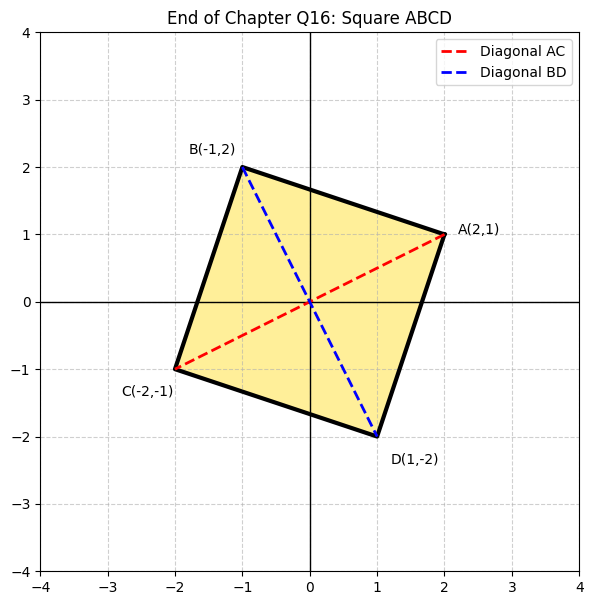
- Given: Points \( A(2, 1) \), \( B(-1, 2) \), \( C(-2, -1) \), and \( D(1, -2) \).
- Step-by-Step Working:
- Calculate sides: \( AB = \sqrt{(-1 – 2)^2 + (2 – 1)^2} = \sqrt{(-3)^2 + 1^2} = \sqrt{10} \).
- \( BC = \sqrt{(-2 – (-1))^2 + (-1 – 2)^2} = \sqrt{10} \). \( CD = \sqrt{10} \). \( DA = \sqrt{10} \). (It is a rhombus).
- Calculate diagonals: \( AC = \sqrt{(-2 – 2)^2 + (-1 – 1)^2} = \sqrt{(-4)^2 + (-2)^2} = \sqrt{20} \).
- \( BD = \sqrt{(1 – (-1))^2 + (-2 – 2)^2} = \sqrt{2^2 + (-4)^2} = \sqrt{20} \).
- Area = \( \sqrt{10} \times \sqrt{10} = 10 \).
- Final Answer: Yes, ABCD is a square because all four sides are equal (\( \sqrt{10} \)) and both diagonals are equal (\( \sqrt{20} \)). The area of the square is 10 square units.