Class 10 Mid Term Mathematics Practice Paper 7
by
cbseassistance
·
August 23, 2026
CBSEASSISTANCE.COM
MID TERM PAPERS
CLASS 10
PAPER 7
Section A
1.
If \( p^2 = \frac{32}{50} \), then \( p \) is a/an
a) integer
b) whole number
c) rational number
d) irrational number
2.
Prime factorisation of 882 is:
a) \( 2^3 \times 3 \times 7^2 \)
b) \( 2^2 \times 3^2 \times 7 \)
c) \( 2^2 \times 3^3 \times 7 \)
d) \( 2 \times 3^2 \times 7^2 \)
3.
If \( p \) and \( q \) are co-prime numbers, then \( p^2 \) and \( q^2 \) are
a) not coprime
b) odd
c) coprime
d) even
4.
The prime factorisation of 1728 is
a) \( 2^5 \times 3^4 \)
b) \( 2^6 \times 3^2 \)
c) \( 2^5 \times 3^3 \)
d) \( 2^6 \times 3^3 \)
5.
A quadratic polynomial with sum and product of its zeros as 8 and -9 respectively is
a) \( x^2 + 8x – 9 \)
b) \( x^2 – 8x – 9 \)
c) \( x^2 – 8x + 9 \)
d) \( x^2 + 8x + 9 \)
6.
Given that one of the zeroes of the quadratic polynomial \( ax^2 + bx + c \) is zero, then the other zero is
a) \( \frac{-c}{a} \)
b) \( \frac{-b}{a} \)
c) \( \frac{c}{a} \)
d) \( \frac{b}{a} \)
7.
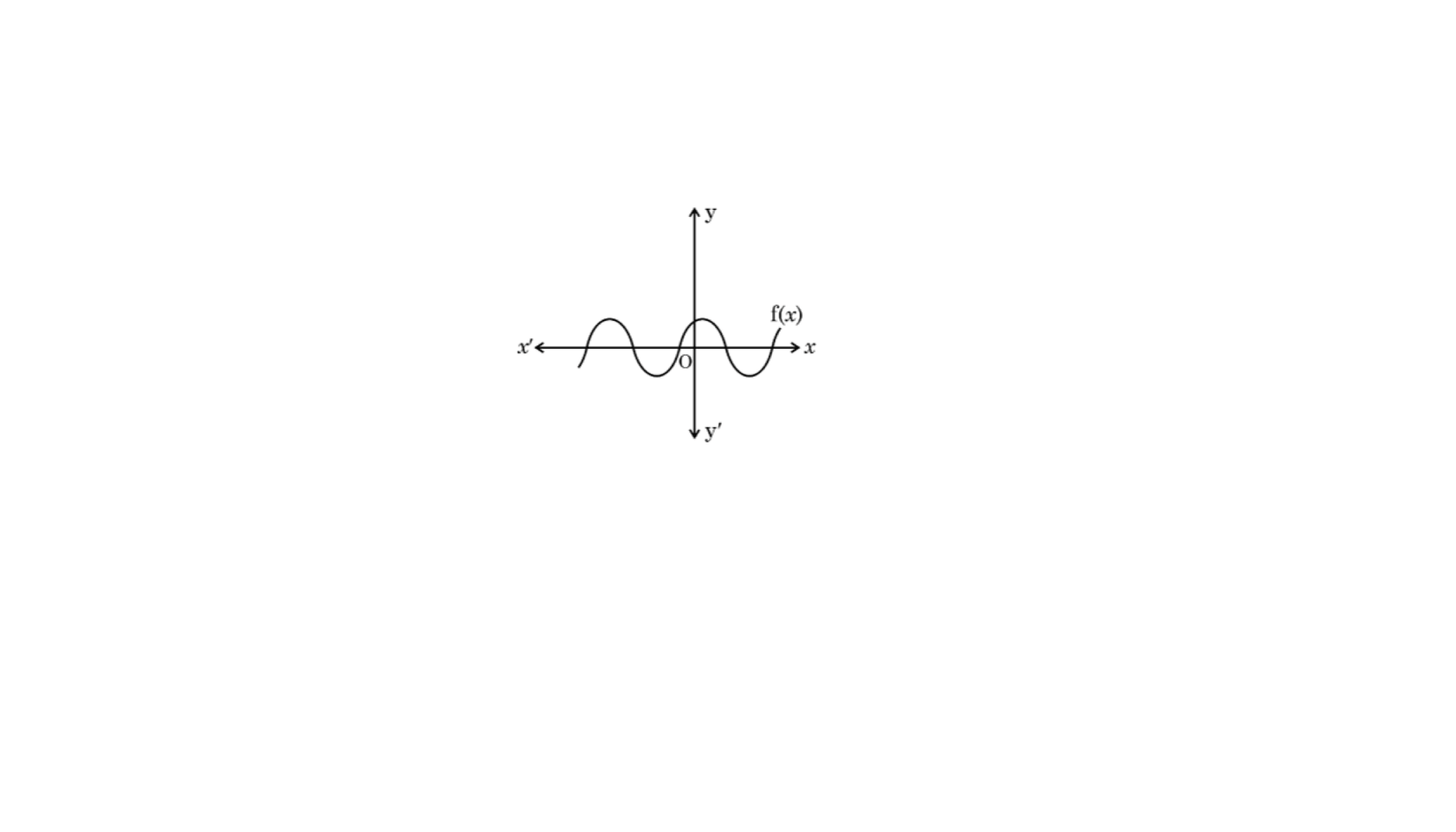
The graph of \( y = f(x) \) is shown in the figure for some polynomial \( f(x) \).
The number of zeroes of \( f(x) \) is
8.
If \( \alpha \) and \( \beta \) are zeroes of the polynomial \( 5x^2 + 3x – 7 \), the value of \( \frac{1}{\alpha} + \frac{1}{\beta} \) is
a) \( -\frac{5}{7} \)
b) \( \frac{3}{7} \)
c) \( \frac{3}{5} \)
d) \( -\frac{3}{7} \)
9.
If \( 2x + 3y = 15 \) and \( 3x + 2y = 25 \), then the value of \( x – y \) is:
10.
The value of \( k \) for which the system of equations \( kx + 2y = 5 \) and \( 3x + 4y = 1 \) have no solution, is
a) \( k = 15 \)
b) \( k \neq \frac{2}{3} \)
c) \( k \neq \frac{3}{2} \)
d) \( k = \frac{3}{2} \)
11.
The value of \( c \) for which the equation \( ax^2 + 2bx + c = 0 \) has equal roots is
a) \( \frac{b^2}{a} \)
b) \( \frac{b^2}{4a} \)
c) \( \frac{a^2}{b} \)
d) \( \frac{a^2}{4b} \)
12.
The quadratic equation \( 2x^2 – \sqrt{5}x + 1 = 0 \) has
a) two distinct real roots
b) more than 2 real roots
c) no real root
d) two equal real roots
13.
The 7th term of an AP is -1 and its 16th term is 17. The nth term of the AP is
a) \( (3n + 8) \)
b) \( (15 – 2n) \)
c) \( (4n – 7) \)
d) \( (2n – 15) \)
14.
If \( a_1, a_2, a_3, \dots \) is an A.P. such that \( \frac{a_4}{a_7} = \frac{2}{3} \), then its 13th term is
15.
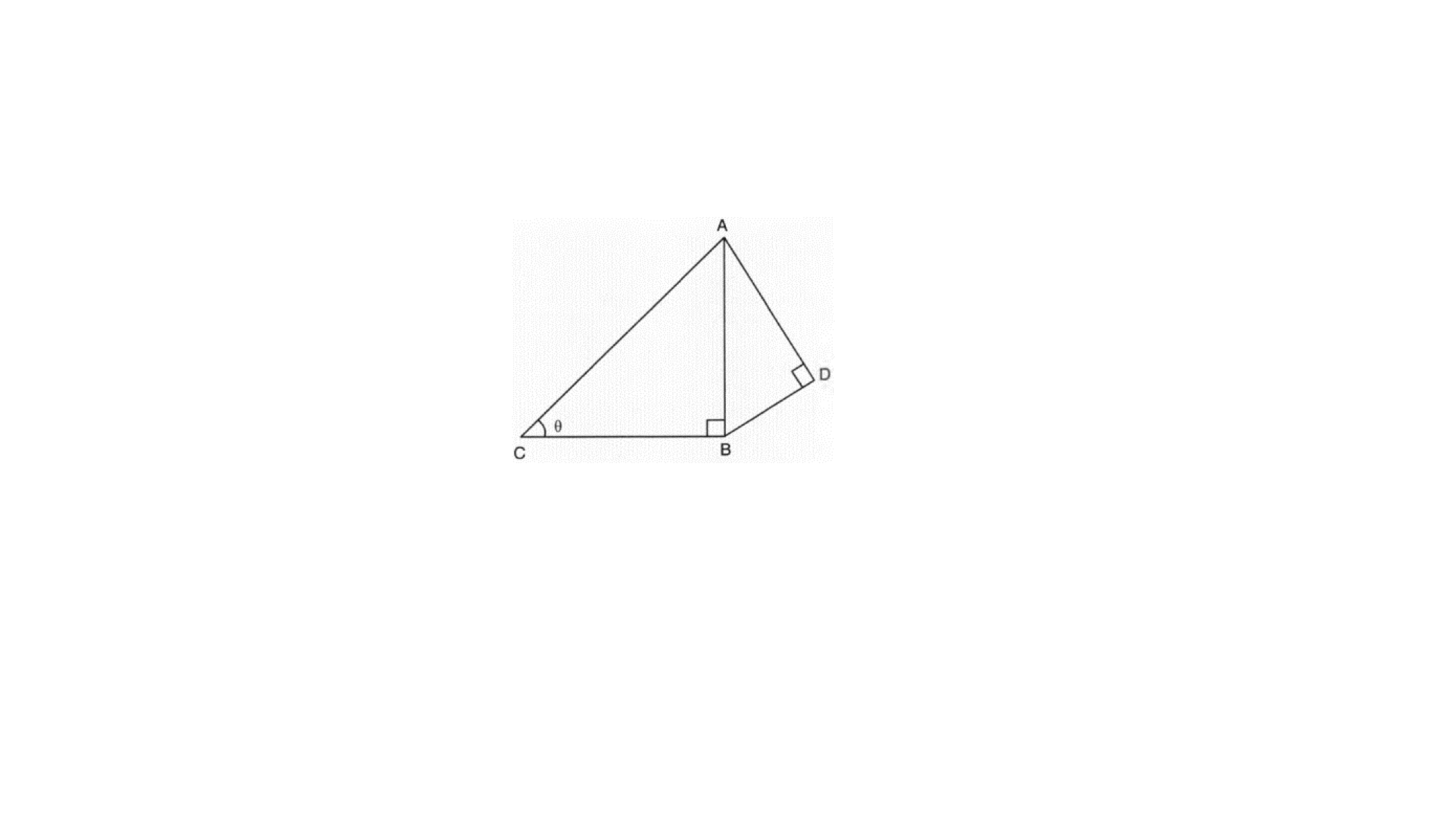
In the given figure, if AD = 4 cm, BD = 3 and CB = 12 cm, then \( \cot\theta \) is
a) \( \frac{5}{12} \)
b) \( \frac{12}{13} \)
c) \( \frac{13}{12} \)
d) \( \frac{12}{5} \)
16.
If \( \tan^2 45^\circ – \cos^2 30^\circ = x \sin 45^\circ \cos 45^\circ \), then \( x = \)
a) \( -\frac{1}{2} \)
b) 2
c) -2
d) \( \frac{1}{2} \)
17.
A vertical pole 10 m long casts a shadow of length 5 m on the ground. At the same time, a tower casts a shadow of length 12.5 m on the ground. The height of the tower is:
a) 24 m
b) 22 m
c) 25 m
d) 20 m
18.
The tops of two poles of height 16 m and 10 m are connected by a wire of length \( l \) meters. If the wire makes an angle of \( 30^\circ \) with the horizontal, then \( l = \)
For question numbers 19 to 20, two statements are given- one labelled Assertion (A) and the other labelled Reason (R). Select the correct answer to these questions from the codes (a), (b), (c) and (d) as given below:
- Both A and R are true and R is the correct explanation of A.
- Both A and R are true but R is not the correct explanation of A.
- A is true but R is false.
- A is false but R is true.
19.
Assertion (A): \( (2x – 1)^2 – 4x^2 + 5 = 0 \) is not a quadratic equation.
Reason (R): \( x = 0, 3 \) are the roots of the equation \( 2x^2 – 6x = 0 \)
20.
Assertion (A): The sum of series with the nth term \( t_n = (9 – 5n) \) is 220 when no. of terms \( n = 6 \).
Reason (R): Sum of first \( n \) terms in an A.P. is given by the formula:
\( S_n = \frac{n}{2} \times [2a + (n – 1)d] \)
Section B
21.
Find a quadratic polynomial whose one zero is 7 and sum of zeroes is -18.
OR
Find the zeroes of \( 4x^2 + 24x + 36 \) and verify the relationship between the zeroes and their coefficients.
22.
Find the value of \( k \) such that the polynomial \( x^2 – (k + 6)x + 2(2k – 1) \) has sum of its zeroes equal to half of their product.
23.
Solve:
\( ax + by = a – b \)
\( bx – ay = a + b \)
24.
Using the formula, \( \sin A = \sqrt{\frac{1 – \cos 2A}{2}} \) find the value of \( \cos 30^\circ \), it being given that \( \cos 60^\circ = \frac{1}{2} \)
OR
Verify that, \( \cos 60^\circ = \cos^2 30^\circ – \sin^2 30^\circ = \frac{1}{2} \).
25.
The angle of depression of a car, standing on the ground, from the top of a 75 m high tower is \( 30^\circ \). What is the distance of the car from the base of the tower?
Section C
26.
Show that \( (2 + \sqrt{3}) \) is an irrational number.
27.
If \( \alpha, \beta \) are zeroes of the quadratic polynomial \( x^2 + 3x + 2 \), find a quadratic polynomial whose zeroes are \( \alpha + 1, \beta + 1 \).
28.
Solve the following system of equation by elimination method:
$$ \frac{x}{2} – \frac{y}{5} = 4 \quad \text{and} \quad \frac{x}{7} + \frac{y}{15} = 3 $$
29.
Find the value of \( k \) for which the quadratic equation \( (k + 1)x^2 – 6(k + 1)x + 3(k + 9) = 0 \), \( k \neq -1 \) has equal roots.
30.
Prove: \( \sin^6 A + 3\sin^2 A\cos^2 A = 1 – \cos^6 A \)
OR
Prove that: \( \sec A(1 – \sin A)(\sec A + \tan A) = 1 \)
31.
At a point on level ground, the angle of elevation of a vertical tower is, found to be \( \alpha \) such that \( \tan \alpha = \frac{1}{3} \). After walking 100 m towards the tower, the angle of elevation \( \beta \) becomes such that \( \tan \beta = \frac{3}{4} \). Find the height of the tower.
OR
If the altitude of the Sun is \( 60^\circ \), what is the height of a tower which casts a shadow of length 30 m?
Section D
32.
Solve the pair of linear equations \( 4x + y + 7 = 0 \) and \( 2x – 3y + 7 = 0 \) graphically.
33.
A cottage industry produces a certain number of toys in a day. The cost of production of each toy (in rupees) was found to be 55 minus the number of toys produced in a day. On a particular day, the total cost of production was ₹ 750. We would like to find out the number of toys produced on that day. Represent the situations mathematically (quadratic equation).
OR
A train travels at a certain average speed for a distance of 360 km. It would have taken 48 minutes less to travel the same distance if its speed was 5 km/hour more. Find the original speed of the train.
34.
Let there be an A.P. with first term ‘a’, common difference ‘d’. If \( a_n \) denotes its \( n^\text{th} \) term and \( S_n \) the sum of first \( n \) terms, find \( d \), if \( a = 3 \), \( n = 8 \) and \( S_n = 192 \).
OR
The ratio of the sums of first \( m \) and first \( n \) terms of an AP is \( m^2 : n^2 \). Show that the ratio of its mth and nth terms is \( (2m – 1) : (2n – 1) \).
35.
If \( \csc\theta + \cot\theta = p \), then prove that \( \cos\theta = \frac{p^2 – 1}{p^2 + 1} \).
Section E
36.
Read the following text carefully and answer the questions that follow:
Teaching Mathematics through activities is a powerful approach that enhances students’ understanding and engagement. Keeping this in mind, Ms. Mukta planned a prime number game for class 5 students. She announces the number 2 in her class and asked the first student to multiply it by a prime number and then pass it to second student. Second student also multiplied it by a prime number and passed it to third student. In this way by multiplying to a prime number, the last student got 173250.
Now, Mukta asked some questions as given below to the students:
37.
Read the following text carefully and answer the questions that follow:
Elpis Technology is a laptop manufacturer. The company works for many branded laptop companies and also provides them with spare parts. Elpis Technology produced 6000 units in 3rd year and 7000 units in the 7th year.
Assuming that production increases uniformly by a fixed number every year.
38.
Read the following text carefully and answer the questions that follow:
A hot air balloon is rising vertically from a point A on the ground which is at distance of 100m from a car parked at a point P on the ground. Amar, who is riding the balloon, observes that it took him 15 seconds to reach a point B which he estimated to be equal to the horizontal distance of his starting point from the car parked at P.