Ganit Manjari Class 9 Math Chapter 9 Solutions: Propositions and their Converses
CBSEASSISTANCE.COM
PROPOSITIONS AND THEIR CONVERSES
CLASS 9
Detailed Solutions (CBSE Norms)
Question: Consider Proposition P: “If it rains, then the road is wet” and its Converse Q: “If the road is wet, then it has rained.” Proposition P is true, but its converse Q may not be true. Give a counterexample.
Core Concept: Understanding that everyday cause-and-effect statements do not always work in reverse. A counterexample is a specific scenario that proves a statement false.
Detailed Solution:
- Proposition P: If it rains, then the road is wet.
- Truth: True. Rain falling from the sky will naturally make exposed roads wet.
- Converse Q: If the road is wet, then it has rained.
- Truth: False. We need to find a situation where the road is wet (the “If” part is true), but it did NOT rain (the “then” part is false).
- Counterexample: The road might be wet because a municipal water tanker spilled water on it, or someone washed their car on the street, or a water pipe burst. In all these cases, the road is wet without any rain.
Conclusion: The original statement is true, but finding just one alternative reason for the road being wet is enough to prove the converse statement is false.
Question: Proposition P: If a number is a multiple of 6, then it is a multiple of 3. Converse Q: If a number is a multiple of 3, then it is a multiple of 6. Justify why Proposition P is true. Determine if Converse Q is true and if not, give a counterexample.
Core Concept: Divisibility rules and multiples. If a number is a multiple of x, it is also a multiple of all the factors of x.
Detailed Solution:
- Justification for Proposition P (True):
- Let n be a number that is a multiple of 6.
- This means n can be written as n = 6 × k (where k is an integer).
- We know that the prime factorization of 6 is 2 × 3.
- Substituting this into our equation gives: n = (2 × 3) × k.
- We can regroup this as: n = 3 × (2k).
- Since (2k) is an integer, n is clearly a multiple of 3. Thus, Proposition P is strictly true.
- Evaluating Converse Q (False):
- We need to see if every multiple of 3 is also a multiple of 6.
- Counterexample: Let us take the number 9.
- 9 is a multiple of 3 (since 3 × 3 = 9).
- However, 9 is not a multiple of 6 (since no integer multiplied by 6 equals 9).
Conclusion: Being a multiple of 6 guarantees being a multiple of 3, but the reverse is false.
Question: In this example, n is any positive integer.
Proposition P: If n is a perfect square, then it has an odd number of factors.
Converse Q: If n has an odd number of factors, then it is a perfect square.
Which of them are true? Justify your answer based on the discussion provided in the text.
Core Concept: Factor pairs of integers. Every factor of a number usually pairs with another distinct factor, unless the number is a perfect square.
Detailed Solution:
- Proving Converse Q (True):
- Every factor of a number n pairs with a “partner” factor to multiply to n (e.g., for 12, the pairs are (1,12), (2,6), (3,4)).
- If n has an odd number of total factors, it is impossible for all factors to be paired up with different numbers.
- There must be exactly one pair where the “partner” is the exact same number (say, f pairs with f).
- Therefore, f × f = n, which means n = f2. By definition, n is a perfect square.
- Proving Proposition P (True):
- Let n be a perfect square. This means there is an integer f such that n = f × f.
- All other factors of n (besides f) will occur in distinct pairs (say, a and b where a ≠ b and a × b = n).
- Because distinct pairs always contribute 2 factors, they make an even sum.
- The repeating factor f only counts as 1 distinct factor.
- Adding an even number (the distinct pairs) + 1 (the repeating factor) always results in an odd total number of factors.
Conclusion: In this unique mathematical case, both the proposition and its converse are completely true. They “imply each other.”
Question: Proposition P: If two triangles have the same area, then they are congruent.
Converse Q: If two triangles are congruent, then they have the same area.
Determine if these statements are true or not. Justify the true statements and give a counterexample for each false statement.
Core Concept: The difference between “Area” (space occupied) and “Congruence” (exact identical shape and size).

Detailed Solution:
- Evaluating Proposition P (False):
- Meaning: Do all triangles with equal areas have to be identical in shape? No.
- Counterexample:
- Consider a right-angled triangle with base = 4 cm and height = 3 cm. Area = ½ × 4 × 3 = 6 sq cm.
- Now, consider an isosceles triangle with base = 6 cm and height = 2 cm. Area = ½ × 6 × 2 = 6 sq cm.
- Both triangles have an area of 6 sq cm, but they clearly have different shapes and side lengths. They are not congruent.
- Evaluating Converse Q (True):
- Meaning: If two triangles are congruent, do they have the same area? Yes.
- Justification: By definition, congruent triangles have exactly the same shape and size. Their corresponding bases and corresponding altitudes (heights) are strictly equal. Since Area = ½ × base × height, putting identical values into the formula will naturally yield identical areas.
Conclusion: Congruence guarantees equal area, but equal area does not guarantee congruence.
Question: Let a, b, c be the sidelengths of a triangle. The Baudhayana-Pythagoras theorem states: “If the triangle is right-angled, then a2 + b2 = c2.” Frame its converse and prove whether it is true using the SSS criterion.
Core Concept: The Converse of the Pythagoras Theorem. We will prove it using geometric construction and the SSS (Side-Side-Side) Congruence rule.

Detailed Solution:
- Converse Statement: Let a, b, c be the sidelengths of a triangle. If a2 + b2 = c2, then the triangle is right-angled.
- Given: A triangle ΔABC with side lengths BC = a, AC = b, and AB = c, such that a2 + b2 = c2.
- To Prove: ΔABC is a right-angled triangle (specifically, ∠C = 90°).
- Construction: Construct a completely new, separate right-angled triangle ΔXYZ, where ∠Z = 90°, base YZ = a, and perpendicular XZ = b.
- Proof:
- In the constructed triangle ΔXYZ, since ∠Z = 90°, we can apply the standard Pythagoras theorem:
XY2 = YZ2 + XZ2 - Substitute the constructed lengths (YZ = a, XZ = b):
XY2 = a2 + b2 —— (Equation 1) - However, we are originally given for ΔABC that:
c2 = a2 + b2 —— (Equation 2) - Comparing Equation 1 and Equation 2, we get:
XY2 = c2
Therefore, XY = c (taking the positive square root). - Now, let us compare the two triangles, ΔABC and ΔXYZ:
- BC = YZ (Both are equal to a, by construction)
- AC = XZ (Both are equal to b, by construction)
- AB = XY (Both are equal to c, proved in step 4)
- By the SSS (Side-Side-Side) Congruence Criterion, ΔABC ≅ ΔXYZ.
- Since the triangles are congruent, their corresponding angles must be equal (CPCT).
Therefore, ∠C = ∠Z. - Since ∠Z = 90° (by construction), ∠C must also be 90°.
- In the constructed triangle ΔXYZ, since ∠Z = 90°, we can apply the standard Pythagoras theorem:
Conclusion: Because ∠C = 90°, ΔABC is a right-angled triangle. Thus, the converse of the Baudhayana-Pythagoras theorem is mathematically true.
Question: We have proved the first statement in an earlier grade. Is the second statement true? Can you prove it? (Statement 2: If two angles of a triangle are equal, then the sides opposite the equal angles have equal lengths.) (Hint: Draw the altitude from the vertex containing the third angle.)
Core Concept: This question asks us to prove the converse of the isosceles triangle theorem. We will use the AAS (Angle-Angle-Side) Congruence Criterion to prove it.

Detailed Solution:
- Given: A triangle ABC in which two angles are equal, i.e., ∠B = ∠C.
- To Prove: The sides opposite to these angles are equal in length, i.e., AC = AB.
- Construction: Draw an altitude AD from vertex A perpendicular to side BC. (This means ∠ADB = ∠ADC = 90°).
- Proof:
- Consider ΔABD and ΔACD.
- ∠B = ∠C [Given]
- ∠ADB = ∠ADC = 90° [By Construction, AD ⊥ BC]
- AD = AD [Common side to both triangles]
- Therefore, by AAS (Angle-Angle-Side) Congruence Rule, ΔABD ≅ ΔACD.
- Since the triangles are congruent, their corresponding parts are equal. Therefore, AB = AC [By CPCT – Corresponding Parts of Congruent Triangles].
Conclusion: Yes, the second statement is true, and we have successfully proven that sides opposite to equal angles of a triangle are equal.
Question: It can also happen that both the proposition and converse are false! Can you give an example?
Core Concept: A proposition is a statement that can be true or false. Its converse swaps the “If” and “Then” parts. We need an example where both the original statement and the swapped statement are logically incorrect.
Detailed Solution:
- Let’s create Proposition P: If a number is a multiple of 2, then it is a multiple of 5.
- Is this true? No. Counterexample: 4 is a multiple of 2, but it is not a multiple of 5. So, Proposition P is false.
- Let’s frame Converse Q: If a number is a multiple of 5, then it is a multiple of 2.
- Is this true? No. Counterexample: 15 is a multiple of 5, but it is not a multiple of 2 (it is odd). So, Converse Q is also false.
Conclusion: We have successfully created a mathematical scenario where both the original proposition and its converse are completely false.
Question 1: Identify real-life examples in which a proposition is true but not the converse. Give nice counterexamples!
Core Concept: We are applying logical framing to everyday scenarios to distinguish between a one-way truth and a two-way truth.
Detailed Solution:
- Proposition: If it is a dog, then it is an animal.
- Truth: True. Every dog belongs to the animal kingdom.
- Converse: If it is an animal, then it is a dog.
- Truth: False.
- Counterexample: A cat is an animal, but it is definitely not a dog!
Question 2: Give more examples from geometry as well as number theory in which a proposition is true but not its converse. Give appropriate counterexamples.
Detailed Solution (Geometry Example):
- Proposition: If a quadrilateral is a rectangle, then it has four sides. (True)
- Converse: If a polygon has four sides, then it is a rectangle. (False)
- Counterexample: A kite has four sides, but its angles are not 90°, so it is not a rectangle.
Detailed Solution (Number Theory Example):
- Proposition: If a number is divisible by 10, then it is divisible by 5. (True, because 10 = 2 × 5)
- Converse: If a number is divisible by 5, then it is divisible by 10. (False)
- Counterexample: The number 15 is divisible by 5, but it is not divisible by 10.
Conclusion: Logic behaves the same way in real life, geometry, and number theory. Swapping the conditions often breaks the truth of the statement.
General Instructions: For questions 1-12, frame the converse, determine if each is true, justify the true ones, and give counterexamples for the false ones.
Question: If two lines are parallel, then the corresponding angles formed by a transversal are equal.
Core Concept: Angles made by a transversal line intersecting parallel lines.
Detailed Solution:
- Converse: If the corresponding angles formed by a transversal intersecting two lines are equal, then the two lines are parallel.
- Truth of Proposition: True. This is a fundamental axiom in Euclidean geometry (Corresponding Angles Axiom).
- Truth of Converse: True. This is the converse of the Corresponding Angles Axiom, which is also universally accepted as a geometric truth to prove lines are parallel.
Conclusion: Both the proposition and its converse are mathematically true.
Question: If a quadrilateral is a square, then all its angles are equal.
Core Concept: Properties of different quadrilaterals (Squares vs. Rectangles).
Detailed Solution:
- Converse: If all the angles of a quadrilateral are equal, then it is a square.
- Truth of Proposition: True. By definition, a square has four angles measuring 90° each.
- Truth of Converse: False.
- Counterexample: Consider a non-square rectangle (e.g., length = 5 cm, breadth = 3 cm). All of its angles are equal (all are 90°), but its adjacent sides are not equal, so it is not a square.
Conclusion: The proposition is true, but its converse is false because rectangles also share the property of having equal angles.
Question: Given any ΔABC, let us bisect the angles at B and C. The bisectors meet at the incentre I. Extend the bisectors beyond I till they meet opposite sides at E and F. If AB = AC, then IE = IF.
Core Concept: Properties of Isosceles triangles, Angle Bisectors, and Triangle Congruence (ASA).
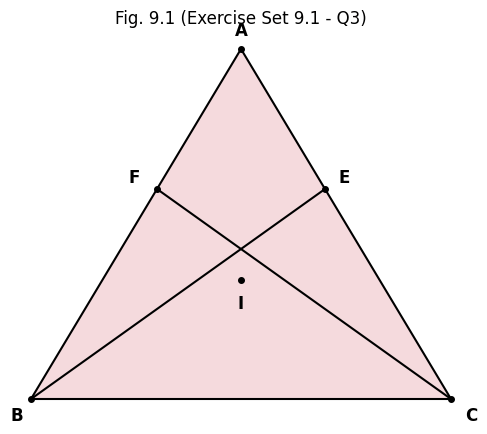
Detailed Solution:
- Converse: If IE = IF, then AB = AC.
- Truth of Proposition: True.
- Justification: In ΔABC, given AB = AC, so ∠ABC = ∠ACB (angles opposite equal sides).
- Since BE and CF are bisectors, ½∠ABC = ½∠ACB ⇒ ∠IBC = ∠ICB.
- In ΔIBC, since base angles are equal, IB = IC.
- Now, consider ΔFBC and ΔECB: ∠FBC = ∠ECB (Original angles B and C), BC = CB (Common side), ∠FCB = ∠EBC (Halves of equal angles).
- By ASA congruence, ΔFBC ≅ ΔECB. Therefore, by CPCT, CF = BE.
- We know IF = CF − IC and IE = BE − IB. Since CF = BE and IC = IB, we get IF = IE.
- Truth of Converse: True.
- Justification: If the segments of the angle bisectors from the incentre to the opposite sides are equal (IE = IF), the triangle is guaranteed to be isosceles (AB = AC). (This relies on symmetry properties of the incentre).
Conclusion: Both the given geometrical proposition and its converse are true.
Question: If x = y, then a + x = a + y, where x, y, and a are any three numbers.
Core Concept: The Addition Property of Equality (Euclid’s Axiom: If equals are added to equals, the wholes are equal).
Detailed Solution:
- Converse: If a + x = a + y, then x = y.
- Truth of Proposition: True. If you add the exact same number (a) to two numbers that are already identical, their sums will obviously be identical.
- Truth of Converse: True.
- Justification: Let’s take a + x = a + y. If we subtract ‘a‘ from both sides (Subtraction Property of Equality), we get x = y.
Conclusion: Both the proposition and its converse are true and routinely used in solving basic algebraic equations.
Question: If a and b are perfect squares, then ab is a perfect square.
Core Concept: Properties of perfect squares and exponents.
Detailed Solution:
- Converse: If ab is a perfect square, then a and b are perfect squares.
- Truth of Proposition: True.
- Justification: If a and b are perfect squares, let a = m2 and b = n2. Then ab = (m2)(n2) = (mn)2. Since (mn) is an integer, ab is a perfect square.
- Truth of Converse: False.
- Counterexample: Let a = 2 and b = 8. Neither 2 nor 8 is a perfect square. However, their product is ab = 2 × 8 = 16, and 16 is a perfect square (42).
Conclusion: The proposition is true, but the converse fails because non-square numbers can multiply together to form a square number.
Question: If x = y, then x2 = y2 (where x and y are real numbers).
Core Concept: Squaring real numbers (both positive and negative).
Detailed Solution:
- Converse: If x2 = y2, then x = y.
- Truth of Proposition: True. Multiplying equal values by equal values yields an equal result.
- Truth of Converse: False.
- Counterexample: Let x = 3 and y = −3. Here, x2 = (3)2 = 9, and y2 = (−3)2 = 9. So, x2 = y2 holds true. However, 3 ≠ −3. So x does not equal y.
Conclusion: Squaring destroys the negative sign, meaning two different numbers (one positive, one negative) can have the same square. Therefore, the converse is false.
Question: If x = y, then x3 = y3.
Core Concept: Cubing real numbers (which preserves the positive/negative sign).
Detailed Solution:
- Converse: If x3 = y3, then x = y.
- Truth of Proposition: True. Like squaring, cubing two identical numbers gives identical results.
- Truth of Converse: True.
- Justification: Unlike squares, every real number has only one unique, real cube root. For instance, the only real number whose cube is −8 is −2. Therefore, if their cubes are identical, the original numbers must have been identical.
Conclusion: Because odd powers preserve negative signs, both the statement and its converse are true for real numbers.
Question: If n is divisible by 24, then it is divisible by both 4 and 6. (n is a positive integer).
Core Concept: Factors and divisibility. If a number is divisible by X, it is divisible by all the factors of X.
Detailed Solution:
- Converse: If n is divisible by both 4 and 6, then it is divisible by 24.
- Truth of Proposition: True.
- Justification: Since 24 = 4 × 6, any multiple of 24 will inherently contain both 4 and 6 as its factors.
- Truth of Converse: False.
- Counterexample: Let n = 12. The number 12 is divisible by 4 (since 4 × 3 = 12) and it is divisible by 6 (since 6 × 2 = 12). However, 12 is not divisible by 24.
Conclusion: The converse is false because 4 and 6 share a common factor (they are not co-prime). Finding their LCM (which is 12, not 24) reveals the flaw.
Question: If n is divisible by 60, then it is divisible by both 5 and 12.
Core Concept: Divisibility by co-prime numbers.
Detailed Solution:
- Converse: If n is divisible by both 5 and 12, then it is divisible by 60.
- Truth of Proposition: True. Since 5 and 12 are factors of 60, any multiple of 60 is divisible by them.
- Truth of Converse: True.
- Justification: The numbers 5 and 12 are co-prime (their Highest Common Factor is 1). A mathematical rule states that if a number is divisible by two co-prime numbers, it is also divisible by their product. Since 5 × 12 = 60, the converse holds true.
Conclusion: Unlike Q8, the converse here is true because the two numbers (5 and 12) do not share any common factors other than 1.
Question: If n is the square of a prime number, then it has exactly 3 factors.
Core Concept: Prime factorisation and counting the number of divisors.
Detailed Solution:
- Converse: If a number has exactly 3 factors, then n is the square of a prime number.
- Truth of Proposition: True.
- Justification: Let p be a prime number. Its square is p2. The only numbers that can divide p2 without a remainder are 1, p, and p2. That is exactly 3 factors.
- Truth of Converse: True.
- Justification: Every number has 1 and itself (n) as factors. If it has exactly one more factor, that middle factor (x) must multiply by itself to equal n (so n = x2). Furthermore, x must be a prime number. If x were composite, it would break down into more factors, giving n more than 3 factors in total.
Conclusion: A number having exactly 3 factors is a unique property belonging exclusively to squares of prime numbers (e.g., 4, 9, 25, 49).
Question: If n is a product of two unequal prime numbers, then it has exactly 4 divisors.
Core Concept: Factors of composite numbers made of two distinct primes.
Detailed Solution:
- Converse: If n has exactly 4 divisors, then it is a product of two unequal prime numbers.
- Truth of Proposition: True.
- Justification: Let n = p × q (where p and q are different primes). The divisors of n will always be 1, p, q, and pq itself. This is exactly 4 divisors.
- Truth of Converse: False.
- Counterexample: Let n = 8. The divisors of 8 are 1, 2, 4, and 8. That is exactly 4 divisors. However, 8 = 2 × 2 × 2 (23). It is not the product of two unequal prime numbers.
Conclusion: The converse is false because numbers formatted as the cube of a prime (like 23 = 8, or 33 = 27) also have exactly 4 divisors.
Question: If n and n + 3 have no factors in common (other than 1), then n is not a multiple of 3.
Core Concept: Greatest Common Divisor (GCD) and consecutive multiples.
Detailed Solution:
- Converse: If n is not a multiple of 3, then n and n + 3 have no factors in common.
- Truth of Proposition: True.
- Justification: If n were a multiple of 3, let’s say n = 3k. Then n + 3 = 3k + 3 = 3(k + 1). Both would be divisible by 3, meaning they would have a common factor of 3. Thus, if they have no common factors, n cannot be a multiple of 3.
- Truth of Converse: True.
- Justification: The difference between n and n + 3 is exactly 3. Any common divisor of two numbers must also divide their difference. Therefore, the only possible common divisor for n and n + 3 is 3 (or 1). If n is not a multiple of 3, then 3 cannot be a common factor. Thus, their only common factor is 1.
Conclusion: Both statements are logically sound and true.
Question: There are no known ‘neat’ expressions that generate only primes! Find counterexamples to the following claims.
Core Concept: Evaluating algebraic expressions to test for prime numbers. A counterexample is found when the result is a composite number.
Detailed Solution:
- (i) Claim: All numbers of the form 4n2 + 1 are prime.
- Let’s test values of n:
For n = 1: 4(1)2 + 1 = 5 (Prime)
For n = 2: 4(2)2 + 1 = 17 (Prime)
For n = 3: 4(3)2 + 1 = 37 (Prime)
For n = 4: 4(4)2 + 1 = 64 + 1 = 65 - Counterexample: When n = 4, the result is 65. Since 65 = 5 × 13, it is a composite number, disproving the claim.
- Let’s test values of n:
- (ii) Claim: All numbers of the form n2 + n + 11 are prime.
- Hint for this type of problem: If you plug in the constant term (11), it often creates a multiple of that constant!
- Let’s skip straight to testing n = 11:
112 + 11 + 11 = 121 + 11 + 11 = 143. - Counterexample: When n = 11, the result is 143. Since 143 = 11 × 13, it is composite, disproving the claim.
- (iii) Claim: All numbers of the form 4n + 3 are prime.
- Let’s test values:
For n = 1: 4(1) + 3 = 7 (Prime)
For n = 2: 4(2) + 3 = 11 (Prime)
For n = 3: 4(3) + 3 = 12 + 3 = 15 - Counterexample: When n = 3, the result is 15. Since 15 = 3 × 5, it is composite, disproving the claim.
- Let’s test values:
Conclusion: Testing integer values systematically helps us find composite outputs, which serve as perfect counterexamples to sweeping prime-generating claims.
Question: Find counterexamples to the following statements.
Core Concept: Testing conditional statements regarding prime generation using powers of 2.
Detailed Solution:
- (i) Statement: If n is a prime number, then 2n − 1 is a prime number.
- Let’s test prime numbers for n:
n = 2: 22 − 1 = 3 (Prime)
n = 3: 23 − 1 = 7 (Prime)
n = 5: 25 − 1 = 31 (Prime)
n = 7: 27 − 1 = 127 (Prime)
n = 11: 211 − 1 = 2048 − 1 = 2047 - Let’s check if 2047 is prime. It is not divisible by 2, 3, 5, 7, 11, 13, 17, 19. Let’s try 23:
2047 ÷ 23 = 89. - Counterexample: Let prime n = 11. The result is 2047, which is equal to 23 × 89. It is composite.
- Let’s test prime numbers for n:
- (ii) Statement: If n is an even number, then 2n + 1 is a prime number.
- Let’s test even numbers for n:
n = 2: 22 + 1 = 5 (Prime)
n = 4: 24 + 1 = 17 (Prime)
n = 6: 26 + 1 = 64 + 1 = 65 - Counterexample: Let even number n = 6. The result is 65, which is 5 × 13. It is composite.
- Let’s test even numbers for n:
Conclusion: We successfully found exceptions for both statements, proving that they are not universally true.
Question: Consider the statement: ‘If a number is divisible by 8, then it is divisible by both 2 and 4’.
(i) Justify the statement.
(ii) To check whether a given number is divisible by 8, is it enough to check whether it is divisible by 2 and 4? Why or why not?
Core Concept: Divisibility rules and the necessity of co-prime factors.
Detailed Solution:
- (i) Justification: If a number n is divisible by 8, we can write it as n = 8 × k (where k is an integer).
We can rewrite this as n = 2 × (4k). Because 4k is an integer, n is divisible by 2.
We can also rewrite it as n = 4 × (2k). Because 2k is an integer, n is divisible by 4.
Therefore, the statement is completely true. - (ii) Is checking 2 and 4 enough for 8? No, it is not enough.
- Why? The numbers 2 and 4 are not co-prime (they share a common factor of 2).
- Counterexample: Take the number 12. 12 is divisible by 2. 12 is also divisible by 4. However, 12 is not divisible by 8.
Conclusion: For a divisibility check combining two numbers to work, the two base numbers must be co-prime (like 3 and 4 to check for 12, or 5 and 12 to check for 60).
Question: Recall that a shortcut to check whether a given number is divisible by 3 is to add the digits of the number and check if the sum is a multiple of 3. Express the relationship between ‘a number is divisible by 3’ and ‘sum of the digits is a multiple of 3’ using ‘If-then’ sentences.
Core Concept: Translating definitions and rules into conditional (“If-then”) statements.
Detailed Solution:
- Proposition: If the sum of the digits of a number is a multiple of 3, then the number is divisible by 3.
- Converse: If a number is divisible by 3, then the sum of its digits is a multiple of 3.
Conclusion: Both of these ‘If-then’ statements are mathematically true; they represent the complete divisibility rule for the number 3.
Question: Suppose we have identified a category of quadrilaterals called Q. We use two thin sticks to act as diagonals to form Q.
(i) Suppose Q satisfies: “If a quadrilateral is of type Q, then it has equal-length diagonals.”
(a) Should the two sticks be of equal length? Why or why not?
(b) Will it matter how the two sticks are put together?
(ii) Instead, suppose Q satisfies: “If a quadrilateral has equal diagonals, then it is of type Q.”
What will be your answers to (a) and (b) now?
Core Concept: Understanding the difference between a necessary condition (Proposition) and a sufficient condition (Converse) in geometry.
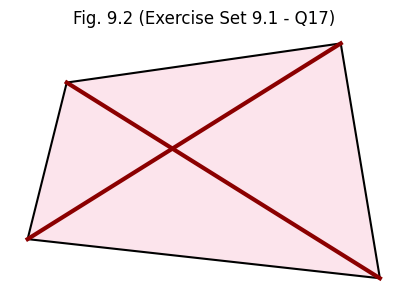
Detailed Solution for Part (i):
- (The statement means: ALL quadrilaterals of type Q have equal diagonals, but having equal diagonals doesn’t necessarily mean it is type Q).
- (a) Should the sticks be equal? Yes. If you are trying to build a quadrilateral of type Q, equal diagonals are a strict requirement (a necessary condition). If you use unequal sticks, you are guaranteed not to get type Q.
- (b) Will it matter how they are put together? Yes. Just crossing two equal sticks doesn’t automatically make it type Q. For example, a rectangle and an isosceles trapezium both have equal diagonals. How you bisect the sticks determines what specific shape you get.
Detailed Solution for Part (ii):
- (The statement is the converse: ANY quadrilateral you ever build with equal diagonals is officially classified as type Q).
- (a) Should the sticks be equal? Yes. To fulfill the “If” part of the statement and guarantee a type Q shape, you must use equal sticks.
- (b) Will it matter how they are put together? No. According to this specific new rule, any way you cross those equal sticks will result in a quadrilateral that satisfies the definition of category Q.
Conclusion: The direction of the “If-then” statement drastically changes how we apply the rule. In part (i), equal diagonals are necessary but not enough on their own. In part (ii), equal diagonals are a 100% guarantee to form shape Q.